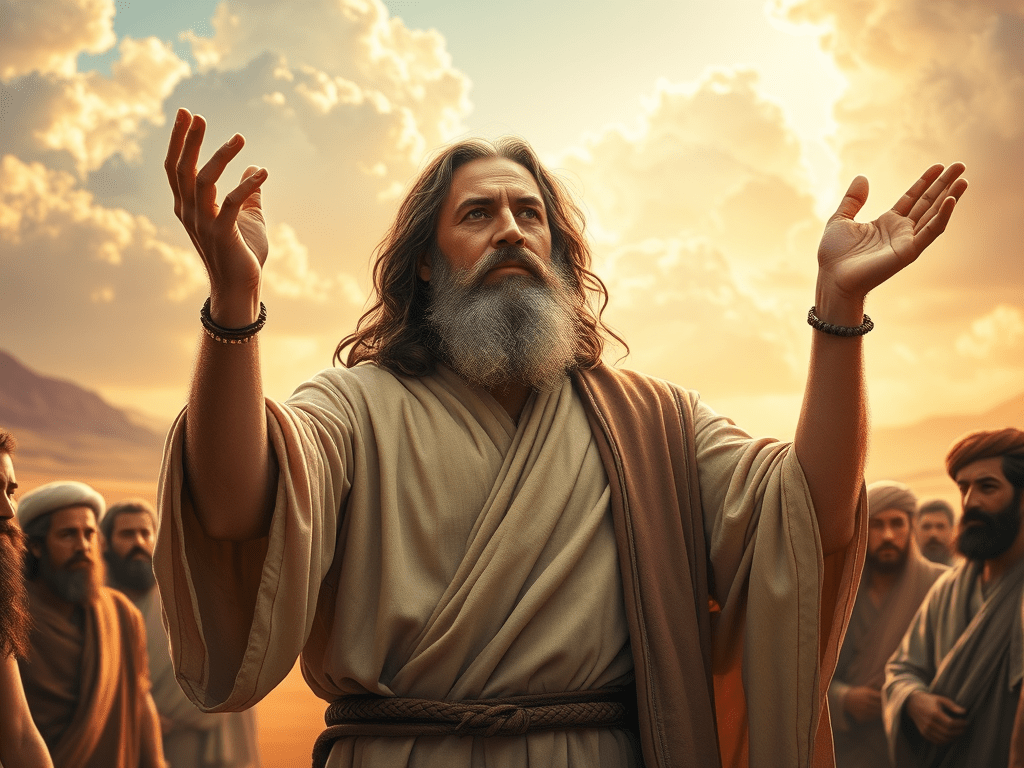
Moses the Mediator: Standing in the Gap for Reconciliation
“So He said He would destroy them—had not Moses His chosen one stood in the breach before Him, to turn away His wrath from destroying them.”
— Psalm 106:23
In the grand narrative of redemption, Moses stands as one of the most striking examples of a mediator—a person chosen by God to intercede, represent, and reconcile a sinful people to a holy and covenantal God. His leadership was not merely political, but profoundly priestly in nature. It was Moses who stood in the gap when Israel sinned. It was Moses who pleaded when God’s wrath was stirred. And it was through Moses that God’s mercy prevailed again and again.
1. The Call: A Mediator Raised by God
God’s first words to Moses in Exodus 3 mark the beginning of his mediatorial role:
“Come now, therefore, and I will send you to Pharaoh that you may bring My people, the children of Israel, out of Egypt.” — Exodus 3:10
This calling was not only to deliver Israel physically, but to stand spiritually between God and His people. Walter Brueggemann comments on this decisive moment by arguing that God’s reconciling work begins with His liberating act. He writes:
“The act of reconciliation is first initiated by the God who hears the cry of the oppressed and appoints Moses as mediator—not only to lead, but to embody the divine intention to redeem and restore.”
(Brueggemann, Theology of the Old Testament, 1997, pp. 174–175)
Thus, Moses is not a self-appointed leader but a God-appointed intercessor, bearing the burden of divine calling with divine authority.
2. The Need for Mediation: Israel’s Rebellion in the Wilderness
Despite witnessing God’s miraculous deliverance from Egypt, Israel’s journey through the wilderness was marked by repeated rebellion and covenant infidelity. One such episode occurs in Numbers 14, when the people refuse to enter the promised land after hearing the discouraging report of ten spies. Their complaint, rooted in fear and distrust, grieved the heart of God and invited His righteous judgment.
In response to this, God declares His intent to disinherit and destroy them (Num. 14:11–12). Yet again, Moses steps forward as mediator, interceding for their preservation—not based on their worthiness, but on God’s reputation among the nations and His covenant promises (Num. 14:13–19).
Here, the role of the mediator becomes essential not merely for the people’s survival but for the very continuity of the covenant relationship.
Walter Brueggemann emphasizes this dynamic by stating:
“Mediation is required not only because of Israel’s persistent disobedience but because the character of God’s covenant allows for passionate engagement. The covenant is not static; it is a living relationship, one that requires a human agent to help carry the weight of divine fidelity in the face of human betrayal.”
— Brueggemann, Theology of the Old Testament, 1997, pp. 252–253
Brueggemann’s insight reinforces that Moses’ role is not simply to “appease” God but to participate in a relational process where God allows the mediator to carry covenant tension. Mediation, then, is not legal arbitration but a deeply personal and covenantal act.
Moses reminds God of His mercy, longsuffering, and covenantal integrity—language that is not only persuasive but grounded in the very nature of Yahweh’s self-revelation. Through Moses’ intercession, the Lord relents, saying:
“I have pardoned, according to your word.” — Numbers 14:20
This response emphasizes the power of faithful mediation. Moses, shaped by the presence of God, becomes a channel through whom mercy flows, and the covenant is preserved.
3. The Golden Calf: A Defining Moment of Intercession
Among the most dramatic and spiritually devastating events in Israel’s early history is the golden calf incident (Exodus 32–34). While Moses ascended Mount Sinai to receive the commandments, the people below grew impatient and persuaded Aaron to make them an idol—a golden image resembling a calf. They declared, “This is your god, O Israel, who brought you up out of the land of Egypt!” (Exo. 32:4)
This blatant act of idolatry was more than rebellion—it was a covenantal breach and spiritual adultery. It fractured the exclusive relationship between Yahweh and His people.
God’s response was fierce:
“Now therefore let Me alone, that My wrath may burn hot against them and I may consume them, in order that I may make a great nation of you.” — Exodus 32:10
At this crucial turning point, Moses steps into the breach with boldness, not to excuse Israel’s sin, but to intercede with covenantal conviction:
“Turn from your fierce wrath; change your mind and do not bring disaster on your people… Remember Abraham, Isaac, and Israel, your servants…” — Exodus 32:12–13
Here, Moses is not pleading sentimentally—he is appealing to God’s own covenantal faithfulness.
Walter Brueggemann, in his exposition of this passage, highlights that this moment is theologically central to the Old Testament understanding of God’s justice and mercy. He writes:
“In this moment, Moses becomes a theological agent who invites God into a reconsideration of divine judgment. The narrative dares to present a God who is not locked in immutable decree but is relationally engaged and willing to be moved by intercessory petition grounded in covenantal memory.”
— Brueggemann, Theology of the Old Testament, 1997, p. 265
Brueggemann challenges the static view of divine wrath and shows that the golden calf story depicts God as responsive within the covenant, and Moses as co-participant in sustaining that covenant through intercessory appeal.
Furthermore, Brueggemann notes that Moses’ refusal to accept God’s offer to start over with him (Exo. 32:10) is deeply significant:
“Moses’ rejection of divine promotion in favor of solidarity with the sinful community is a profound act of covenant loyalty. He risks everything to preserve the bond between God and a broken people.”
Thus, the golden calf incident becomes the quintessential example of mediation, where Moses embodies the burden of leadership, the pain of intercession, and the refusal to sever God’s redemptive plan from a fallen people.
Rather than being destroyed, Israel is spared. And Moses’ faithful mediation prepares the way for covenant renewal in Exodus 34—where God reaffirms His merciful character and restores the relationship.
4. Sacrificial Mediation: Offering Himself for the People
Following the golden calf crisis, Moses does something utterly remarkable—something that transcends political leadership or prophetic warning. He offers himself as a substitute for the sinful people.
“So Moses returned to the Lord and said, ‘Alas, this people has sinned a great sin. They have made for themselves gods of gold. But now, if You will forgive their sin, please do. But if not, blot me out of Your book which You have written.’”
— Exodus 32:31–32
This is one of the most shocking and sacrificial prayers in all of Scripture. Moses does not seek self-preservation or distance himself from the people’s guilt. Rather, he embraces their condition and offers his own life as ransom for their restoration.
Here, we see mediation at its deepest level—a servant leader willing to bear the consequences of his people’s covenantal failure.
W.T. Wedmer, in his article “Theology of Mediation in the Hebrew Scriptures,” argues that this passage reveals a turning point in biblical intercession, one in which the mediator is not merely a spokesperson but a sacrificial figure. He writes:
“Moses does not only represent the people—he stands with them, under the same threat of divine judgment. His willingness to be ‘blotted out’ from God’s book is not rhetorical flair but a serious theological act of identification. He binds himself to their fate, embodying both solidarity and substitution.”
— Wedmer, Journal for Biblical Studies, Vol. 12, 2003, pp. 201–203
Wedmer emphasizes that Moses’ intercession marks a shift from transactional prayer to incarnational mediation. Moses internalizes the burden of the people’s guilt and appeals to God not on the basis of Israel’s repentance (which has not yet occurred), but on the basis of his own sacrificial posture.
This action, Wedmer argues, anticipates a pattern of mediation that is fully realized in Christ:
“Moses, in this moment, becomes an archetype of redemptive intercession—a type of Christ who offers not merely words but his life to restore the covenant.”
— ibid.
What makes this intercession even more compelling is Moses’ reverent boldness. He dares to say, “Forgive them—or take me.” This willingness to absorb divine wrath for others underscores the cost of true reconciliation.
While God does not accept Moses’ offer to bear the penalty of sin (since only the innocent Lamb of God could do that fully), He does respond by relenting from total destruction, reaffirming the covenant, and continuing His presence with the people.
Thus, Moses’ act does not effect atonement in the fullest theological sense, but it becomes a powerful foreshadowing of the gospel—the innocent pleading for the guilty, offering himself for the sake of others, and choosing to stand in the shadow of judgment out of covenantal love.
5. God’s Response: Mercy and Covenant Renewal
After Moses’ bold intercession and sacrificial plea on behalf of the people, God does not immediately restore all things—but He does respond with mercy. Instead of destroying Israel or abandoning His promises, God chooses to renew the covenant and reveal His divine character more fully than ever before.
In Exodus 33–34, Moses once again ascends the mountain to meet with God. There, in the aftermath of rebellion and judgment, God speaks words not of condemnation, but of covenantal reaffirmation:
“The Lord, the Lord God, merciful and gracious, longsuffering, and abundant in goodness and truth, keeping mercy for thousands, forgiving iniquity and transgression and sin…”
— Exodus 34:6–7 (BSI)
This declaration is not merely a theological statement—it is God’s self-revelation in direct response to Moses’ mediation.
Walter Brueggemann sees this moment as the turning point of divine faithfulness in the Old Testament. He writes:
“God’s self-disclosure in Exodus 34 is not a generic description of the deity, but a narrative consequence of Moses’ bold intercession. The divine utterance arises not from detached proclamation but from a deep engagement with the human partner in covenant.”
— Brueggemann, Theology of the Old Testament, 1997, p. 266
In other words, this profound revelation of God’s mercy is evoked by Moses’ faithful advocacy. God allows His character to be known not in abstract theology, but within the relational tension of covenant mediation. Moses’ intercession thus leads to the deepest and most enduring revelation of God in the Torah, forming the theological backbone for all future appeals to His grace, mercy, and justice throughout the Old Testament (see Joel 2:13, Jonah 4:2, Neh. 9:17, and Psalm 103:8).
6. A Typology of Christ: Moses as the Precursor to the True Mediator
The intercessory life of Moses—his willingness to plead, to sacrifice, and to stand in the breach—does not end with Israel’s temporary restoration. Rather, it points beyond itself. Moses is not the ultimate mediator, but he becomes a profound type—a divinely intended foreshadowing—of the One who would truly and eternally reconcile God and man: Jesus Christ.
“For there is one God and one mediator between God and men, the man Christ Jesus, who gave himself as a ransom for all…”
— 1 Timothy 2:5–6
Moses, though flawed and mortal, stands in the divine story as a prefiguration of Christ’s priestly and redemptive work.
St. Augustine, in his theological masterpiece The City of God, draws a powerful connection between Moses and Christ. He writes:
“When Moses pleaded for mercy, he was not excusing the people’s sin. He stood between the living and the dead as a figure of the One who would come—not merely to speak on behalf of sinners, but to bear the penalty of their sin in Himself.”
— Augustine, City of God, Book 10, Chapter 13
Augustine’s reading reflects the patristic approach to Scripture, which often saw in Old Testament figures images and shadows of the coming Christ. Moses becomes, in this sense, a sacramental symbol of divine intercession—pointing toward a better covenant and a perfect Mediator.
Moses offered his life hypothetically (Exo. 32:32), but Christ actually gave His life as a ransom.
Moses pleaded for mercy with God’s covenant in mind, but Christ enacted mercy by fulfilling that covenant through His blood (Luke 22:20; Heb. 8:6).
Moses turned away God’s wrath temporarily; Jesus absorbed it fully and eternally (Romans 3:25; Isaiah 53:5).
As Augustine notes, the difference lies not in heart, but in effect:
“Moses interceded, but could not atone; Christ interceded by atoning, becoming both priest and sacrifice in one.”
Thus, Moses is not the end of the story of mediation—he is the signpost. He prepares us to understand the depth of Jesus’ high priestly work (see Hebrews 3:1–6; 9:11–15). What Moses initiated in shadow, Christ completed in glory.
Will You Stand in the Gap Today?
The story of Moses challenges us not just to admire his example, but to follow it. In a world filled with rebellion, idolatry, and broken covenant, God is still looking for intercessors.
“I sought for a man among them that should make up the hedge, and stand in the gap before Me for the land…”
— Ezekiel 22:30
We are invited into this mediatorial ministry—not as redeemers, but as intercessors, lifting others in prayer, pleading for mercy, and bearing burdens with Christ-like compassion.
– Jonathan Samuel Konala
 Jonathan Samuel's Pilgrim Thoughts
Leave a comment