The Christological Crisis Behind the Text
One of the most important questions in all Christian theology is this: Who is Jesus Christ? Is He the highest of created beings, or is He eternally God, equal with the Father and supreme over all things? That question stood at the center of the early church’s struggle for doctrinal clarity, and it still matters deeply today.
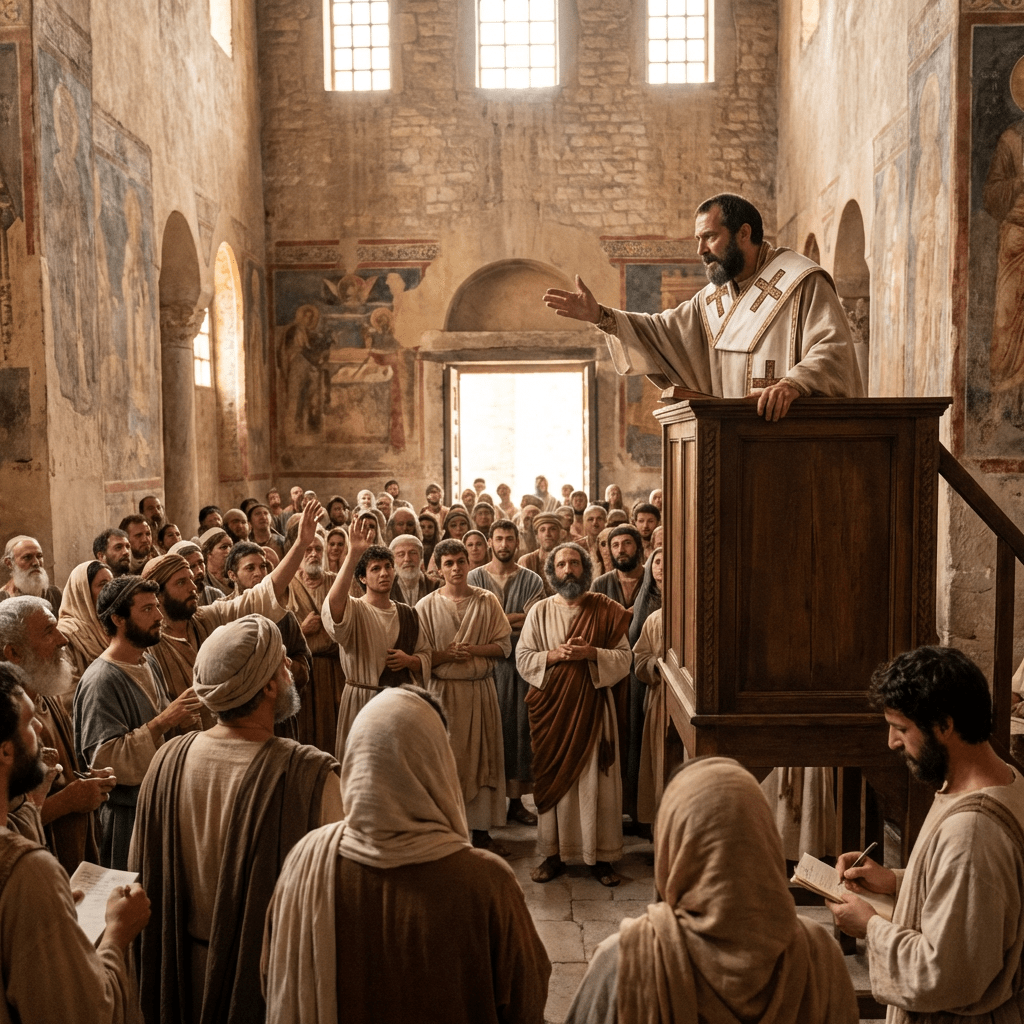
Among the early church fathers who answered this question with boldness and precision, John Chrysostom stands out. William Smith and Henry Wace describe Chrysostom as one of the great figures of the early church, remembered for both his preaching and theological influence (Smith and Wace, A Dictionary of Christian Biography, 1:519). Born in Antioch around A.D. 347, Chrysostom became a deacon, presbyter, and later bishop of Constantinople, and his life was marked by careful biblical interpretation, pastoral concern, and fearless doctrinal defense. The portrait that emerges from the study of his life and writings is that of a preacher who believed that Scripture must be explained faithfully and proclaimed persuasively.
This becomes especially clear in his reading of Colossians 1:15–18, where Paul calls Christ “the image of the invisible God, the firstborn of all creation.” For Chrysostom, this was no minor phrase. It was a decisive text for defending the full deity, supremacy, and eternal dignity of Jesus Christ.
Chrysostom’s Way of Reading Scripture
Chrysostom belonged to the Antiochian school of interpretation, a tradition that valued grammatical, historical, and literal exegesis. David S. Dockery notes that the Antiochene tradition was especially concerned with the historical and textual sense of Scripture, in contrast to overly allegorical readings (Dockery, Biblical Interpretation Then and Now, 113–19). That concern shaped Chrysostom’s whole method.
He did not read Scripture carelessly, nor did he impose ideas onto the text. Instead, he tried to discover what the biblical author truly intended. Theodore Stylianopoulos remarks that Chrysostom’s biblical interpretation reveals both fidelity to the church’s doctrinal convictions and attentiveness to the text itself (Stylianopoulos, “Comments on Chrysostom,” 7). In this way, Chrysostom stands as both a theologian and an expositor.
At the same time, Chrysostom was never dry or mechanical. He believed that Scripture was given not only to inform the mind but to transform the life. Frances Young rightly observes that biblical exegesis in the early church played a major role in shaping Christian culture and Christian understanding (Young, “Biblical Exegesis and the Formation of Christian Culture,” 173). Chrysostom fits that pattern well: he explained Scripture so that people might live under its authority.
Another important feature of his interpretation was his rhetorical skill. Raffaella Cribiore points out that Antioch was a center of rhetorical education, and Chrysostom was shaped within that intellectual world (Cribiore, The School of Libanius in Late Antique Antioch, 11). Margaret Mary Mitchell also shows that Chrysostom’s Pauline interpretation was deeply tied to the art of persuasion, not as empty speech but as a disciplined way of leading hearers into the truth of the text (Mitchell, The Heavenly Trumpet, 40). Lauri Thurén similarly argues that Chrysostom used rhetoric to bring out the natural force of Scripture so that the audience would not merely hear the text but feel its claim upon them (Thurén, “John Chrysostom as a Rhetorical Critic,” 5–6). This same feature appears clearly in his handling of Colossians 1:15.
Why Colossians 1:15 Became So Important
Colossians 1:15 says, “He is the image of the invisible God, the firstborn of all creation.” This verse became one of the great battlegrounds in the church’s Christological debates because opponents of Nicene faith used the word “firstborn” to claim that the Son was a created being.
That is why Chrysostom’s interpretation must be read in its doctrinal setting. R. P. C. Hanson explains that the Arian controversy centered on the question of whether the Son truly shared the being of the Father or existed as a subordinate and derived being (Hanson, The Search for the Christian Doctrine of God, 100–102). Later, Hanson shows how deeply this issue shaped the church’s doctrine of God itself (Hanson, The Search for the Christian Doctrine of God, 562). Guido M. Berndt and Roland Steinacher also note that Arianism was not an isolated idea but a broad and powerful theological movement that reshaped large sections of the Christian world (Berndt and Steinacher, Arianism, 47, 65).
The doctrinal problem, then, was serious. If Christ is merely the first thing God made, He cannot be fully God. If He is not fully God, then the Christian confession of salvation is weakened at its center. Chrysostom understood this clearly, and that is why he responded with such strength.
“The Image of the Invisible God”
Chrysostom begins with the phrase “the image of the invisible God” and approaches it through a series of rhetorical questions. He asks, in effect, who this image is, whose image it is, and what sort of reality Paul intends by using this language. This style is not accidental. It reflects Chrysostom’s conviction that truth should be pressed upon the conscience through thoughtful and persuasive exposition.
For Chrysostom, Christ as the image of God does not mean a weak copy or an inferior likeness. Rather, it points to a true and perfect correspondence. If Christ is the image of the invisible God, then He reveals God truly because He belongs to the divine reality He reveals. This is why Chrysostom rejects any reading that would reduce Christ to a merely human or created figure.
His reasoning harmonizes with the broader biblical witness. Hebrews 1:3 says that the Son is “the radiance of the glory of God and the exact imprint of his nature.” John 14:9 records Jesus saying, “Whoever has seen me has seen the Father.” These passages do not suggest partial resemblance; they point to perfect revelation.
Chrysostom strengthens this point with analogy. Human beings may try to produce likenesses through art, but every human image remains limited and imperfect. Christ, however, is not an imperfect reflection of God. He is the flawless image of the Father, without defect or distortion. That is why the title “image” in Colossians 1:15 must be read as a statement of divine dignity, not creaturely inferiority.
What “Firstborn” Does Not Mean
The debate becomes sharper with the phrase “firstborn of all creation.” Chrysostom refuses to let the Arians define this word. He insists that “firstborn” does not mean “first created.” Instead, it refers to Christ’s rank, supremacy, and preeminence over all creation.
This is an important biblical distinction. In Scripture, “firstborn” often speaks not only of sequence but of status. Psalm 89:27 gives a good example when God says of David, “I will make him the firstborn, the highest of the kings of the earth.” David was not the first king in time, but he was given firstborn status in honor and royal dignity. In the same way, Paul’s language in Colossians presents Christ as supreme over all creation, not as part of creation.
That is why the immediate context matters so much. Colossians 1:16 says, “For by him all things were created.” If all things were created by Him, then He cannot belong to the category of created things. Paul is not placing Christ inside creation but above it, before it, and over it.
Chrysostom’s Scriptural Defense of Christ’s Supremacy
Chrysostom does not stop with a lexical point. He strengthens his case by comparing Scripture with Scripture. One example comes from Hebrews 2:17, where Christ is called our brother. Chrysostom reasons that this title does not reduce Christ to mere humanity or deny His divine nature. Rather, it expresses His real identification with us in the incarnation. In the same way, the title “firstborn” must not be misunderstood as though it strips Him of deity.
He also turns to Colossians 1:18, where Christ is called “the firstborn from the dead.” Here Chrysostom asks another powerful rhetorical question: does this mean Christ was the first one ever to die? Clearly not. The title means that Christ holds the chief and leading place in resurrection life. He is the one who rises in triumph and becomes the source and guarantee of resurrection for His people.
This argument is deeply biblical. Revelation 1:5 also calls Christ “the firstborn of the dead,” and 1 Corinthians 15:20 calls Him “the firstfruits of those who have fallen asleep.” The point is not mere chronology. The point is redemptive supremacy. Christ is the risen Lord who inaugurates the resurrection order.
So when Chrysostom reads “firstborn of all creation,” he reads it in the same way. Christ is not the first item within the universe; He is the supreme Son over the universe. He stands in sovereign dignity above all that exists.
Chrysostom Among His Contemporaries
Chrysostom was not the only church father to combine theology, biblical interpretation, and rhetoric. Other major figures of the period also used persuasive theological language in defense of orthodoxy.
Andrew Selby shows that Ambrose of Milan, especially in his writings on the Holy Spirit, used rhetorical strength not merely to impress people but to deepen doctrinal understanding and reinforce Nicene faith (Selby, Ambrose of Milan’s On the Holy Spirit, 119–26). Christopher Beeley explains that Gregory of Nazianzus joined rhetorical brilliance with theological precision in his defense of the Trinity and the full deity of Christ (Beeley, Re-Reading Gregory of Nazianzus, xi, 30, 40). S. M. Hildebrand, Hans Boersma, and Matthew Levering likewise show that Basil of Caesarea used careful theological exegesis to defend the co-equality of the Holy Spirit (Hildebrand, Boersma, and Levering, Basil of Caesarea, 84). A. Radde-Gallwitz notes that Gregory of Nyssa balanced rhetorical style with doctrinal seriousness and situational relevance (Radde-Gallwitz, Gregory of Nyssa’s Doctrinal Works, 27). These comparisons help us see Chrysostom not as an isolated preacher but as part of a broader patristic effort to defend the faith through faithful exposition.
At the same time, some Christians warned that rhetoric could become dangerous if it overshadowed truth. Augustine acknowledged the usefulness of eloquence but cautioned that eloquence can mislead when it governs the message instead of serving it (Shaw, Saint Augustine On Christian Teaching, 143). Tertullian had earlier shown similar caution, even though he admitted that rhetoric could sometimes help clarify and defend Christian teaching (Burns, “Tertullian, First Theologian of the West,” 42). Chrysostom’s value lies partly in the fact that, at his best, he kept rhetoric under the authority of Scripture.
Why This Matters for the Church Today
Chrysostom’s reading of Colossians 1:15 still matters because the identity of Christ is still the heart of Christian faith. Whenever Jesus is reduced to a created helper, a moral guide, or a lesser divine being, the gospel itself is weakened.
If Christ is only a creature, then He cannot bear the full weight of salvation. A creature cannot fully reveal the invisible God. A creature cannot sustain all things. A creature cannot receive the worship that belongs to God alone. But if Christ is the eternal Son, the perfect image of the Father, and the firstborn over all creation in rank and glory, then He is fully worthy of faith, worship, obedience, and trust.
This is why Chrysostom’s interpretation remains so valuable. He teaches us to read Scripture carefully, to pay attention to context, to compare one biblical passage with another, and above all to let the glory of Christ govern our theology.
The Truth the Church Must Hold
John Chrysostom read Colossians 1:15 with theological seriousness, pastoral wisdom, and biblical care. He saw clearly that the phrase “firstborn of all creation” was never meant to lower Christ into the realm of creatures. Rather, it proclaims His supremacy over all creation, His eternal dignity as the Son, and His rightful place as the perfect image of the invisible God.
In the end, Chrysostom’s message is not merely an argument against ancient heresy. It is a call to the church in every age to behold Christ rightly. The One who made all things cannot be one of the things He made. The One who gives life to the dead cannot be imprisoned within the limits of creation. And the One who perfectly reveals the Father must be honored as Lord over all.
To diminish Christ is to diminish the gospel; but to see Him as He truly is—the eternal Son, supreme over creation—is to stand on holy ground.
Jonathan Samuel Konala M.Tech; M.Th
 Jonathan Samuel's Pilgrim Thoughts
Leave a comment