Introduction
Ekron was not just an ancient Philistine city. In the Bible, it stands as a place that speaks about conflict, unbelief, idolatry, and the judgment of God. It was one of the five chief cities of the Philistines, along with Gaza, Ashkelon, Ashdod, and Gath. Because of this, Ekron often appears in Scripture as part of the long struggle between Israel and the Philistines.
Yet Ekron is more than a geographical name. Its story teaches spiritual lessons. It shows what happens when people resist the purposes of God, trust in idols, and refuse to honor the Lord. At the same time, it shows that God rules over cities, kings, nations, and history itself.
Ekron in the Inheritance of Israel
The first mentions of Ekron appear in the book of Joshua. In Joshua 13:2–3, Ekron is listed among the lands that still remained to be possessed. This means that though God had promised the land to Israel, some parts were still in enemy hands. Later, Joshua 15:11 and 15:45–46 place Ekron within the border of Judah, while Joshua 19:43 connects it with the territory of Dan. This overlap shows that the area was contested and not easy to control.
Judges 1:18 says that Judah took Ekron, but Judges 1:19 says Judah could not drive out the people of the plain because they had iron chariots. As The Anchor Bible Dictionary explains, this tension in the text shows the difference between what was promised and what was fully possessed (David Noel Freedman, Gary A. Herion, David F. Graf, and John David Pleins, The Anchor Bible Dictionary, vol. 2, ed. Trude Dothan and Seymour Gitin [New York: Doubleday, 1992], 425).
This makes Ekron an important biblical picture. It was part of the land promised to God’s people, yet it also remained a place of struggle. In this way, Ekron reminds us that God’s promises are sure, but His people must walk in faith and obedience.
Ekron and the Ark of God
Ekron becomes especially important in 1 Samuel. After the Philistines captured the Ark of the Covenant, they moved it from one city to another. At last the ark came to Ekron. But the people of Ekron were filled with fear. They cried out because they knew the hand of the God of Israel was heavy upon them. They begged that the ark be sent away, lest they die (1 Sam 5:10–11).
This is a striking moment in Scripture. A Philistine city, known for standing against Israel, was forced to acknowledge the power of Israel’s God. John D. Barry notes in The Lexham Bible Dictionary that Ekron’s place in this story shows the supremacy of Yahweh over Philistine territory and Philistine religion (John D. Barry, “Ekron,” in The Lexham Bible Dictionary, ed. David Schreiner [Bellingham, WA: Lexham Press, 2016]).
The lesson is plain and powerful. The God of Israel is not only Lord in Israel. He is Lord everywhere. Even in a pagan city, even among idol worshipers, His holiness cannot be ignored. Ekron learned that the presence of God is not a light thing. His holiness brings blessing to those who honor Him, but terror to those who oppose Him.
Ekron in Israel’s Victory over the Philistines
Ekron is also remembered in connection with Israel’s victories. After David killed Goliath, the Israelites chased the Philistines on the road toward Ekron (1 Sam 17:52). Also, 1 Samuel 7:14 says that cities from Ekron to Gath were restored to Israel. These passages show that Ekron marked the retreat of Philistine power and the triumph of God’s people.
This is important theologically. Ekron was not only a place of fear and idolatry; it also became a witness to the Lord’s deliverance. The same city that resisted Israel became part of the testimony that the Lord fights for His people. When God stretches out His hand, the enemy cannot stand.
Ekron and the Sin of Idolatry
Perhaps the most serious biblical association of Ekron is found in 2 Kings 1. King Ahaziah of Israel fell sick and sent messengers to inquire of Baal-zebub, the god of Ekron, asking whether he would recover. This brought a sharp rebuke from Elijah. Again and again the prophet asked, “Is it because there is no God in Israel, that ye go to inquire of Baal-zebub the god of Ekron?” (2 Kgs 1:3, 6, 16).
Katharine Doob Sakenfeld, in The New Interpreter’s Dictionary of the Bible, observes that this event fixed Ekron in Israel’s memory as a center of pagan religion and apostasy (Katharine Doob Sakenfeld, “Ekron,” in The New Interpreter’s Dictionary of the Bible, vol. 2, ed. Carl S. Ehrlich [Nashville: Abingdon Press, 2006], 227).
This story is not only about an ancient king. It is about the human heart. Ahaziah did not seek the Lord; he sought help from a false god. He turned away from the living God and trusted in something empty. That is the great sin of idolatry. Idolatry is not only bowing before an image. It is placing trust, hope, fear, or dependence in anything other than God.
So Ekron becomes a warning to every generation. Whenever men leave the Lord and look elsewhere for guidance, security, healing, or hope, they walk the path of Ahaziah. The question of Elijah still speaks today: “Is there no God in Israel?” In other words, why should anyone turn away from the living God to trust in what cannot save?
Ekron in the Message of the Prophets
The prophets spoke strongly against Ekron. Jeremiah includes it among the nations that would drink the cup of God’s wrath (Jer 25:20). Amos declares that the ruler of Ekron would perish (Amos 1:8). Zephaniah says that Ekron would be rooted up (Zeph 2:4). Zechariah also speaks of fear and judgment coming upon the Philistine cities, including Ekron (Zech 9:5, 7).
As noted in The Zondervan Encyclopedia of the Bible, these prophetic words show that Ekron had become a symbol of opposition to God and therefore could not escape divine judgment (Merrill C. Tenney and Moisés Silva, eds., The Zondervan Encyclopedia of the Bible, vol. 2, ed. J. P. Lewis [Grand Rapids: Zondervan, 2010], 281–82).
This reveals an important truth. God is patient, but He is also just. Nations may grow strong, cities may become rich, and rulers may exalt themselves, but none of them can stand if they persist in pride and rebellion. The downfall of Ekron teaches that no power can endure against the Lord.
Ekron in Ancient History
History outside the Bible confirms the importance of Ekron. It appears in Assyrian records in the eighth and seventh centuries BC. W. A. Elwell, in the Baker Encyclopedia of the Bible, notes that Sargon II captured Ekron in 712 BC. Later, in 701 BC, Sennacherib crushed a rebellion there, restored the loyal king Padi, and gave him some land taken from Judah (W. A. Elwell, “Ekron,” in Baker Encyclopedia of the Bible, vol. 1, ed. Barry J. Beitzel [Grand Rapids: Baker Books, 1988], 675–76).
These events show that Ekron was deeply involved in the politics of the ancient world. It stood between great powers such as Assyria, Judah, Egypt, and later Babylon. It was not a small or hidden place. It was a city of influence, conflict, and worldly importance.
Yet even here the Bible’s message remains clear. However important Ekron may have seemed in human history, it still stood under the rule of God. Kings and empires moved around it, but the Lord remained above them all.
Ekron’s Prosperity and Pride
Under Assyrian rule, Ekron became wealthy. It grew into a great center for olive oil production and textile work. Sakenfeld notes that the city continued to be known even into the Hellenistic period, and later Eusebius referred to it as a village inhabited by Jews (Sakenfeld, The New Interpreter’s Dictionary of the Bible, 227).
This rise in prosperity is significant. Ekron was not only a city of warfare; it was also a city of wealth. But riches could not protect it from judgment. Economic success could not cleanse its idolatry. Outward growth could not save it from inward corruption.
This too is a lesson for the soul. A people may prosper in trade, culture, and strength, yet still be spiritually poor before God. Wealth is never a substitute for worship. Success is never a substitute for obedience.
Ekron and Archaeological Witness
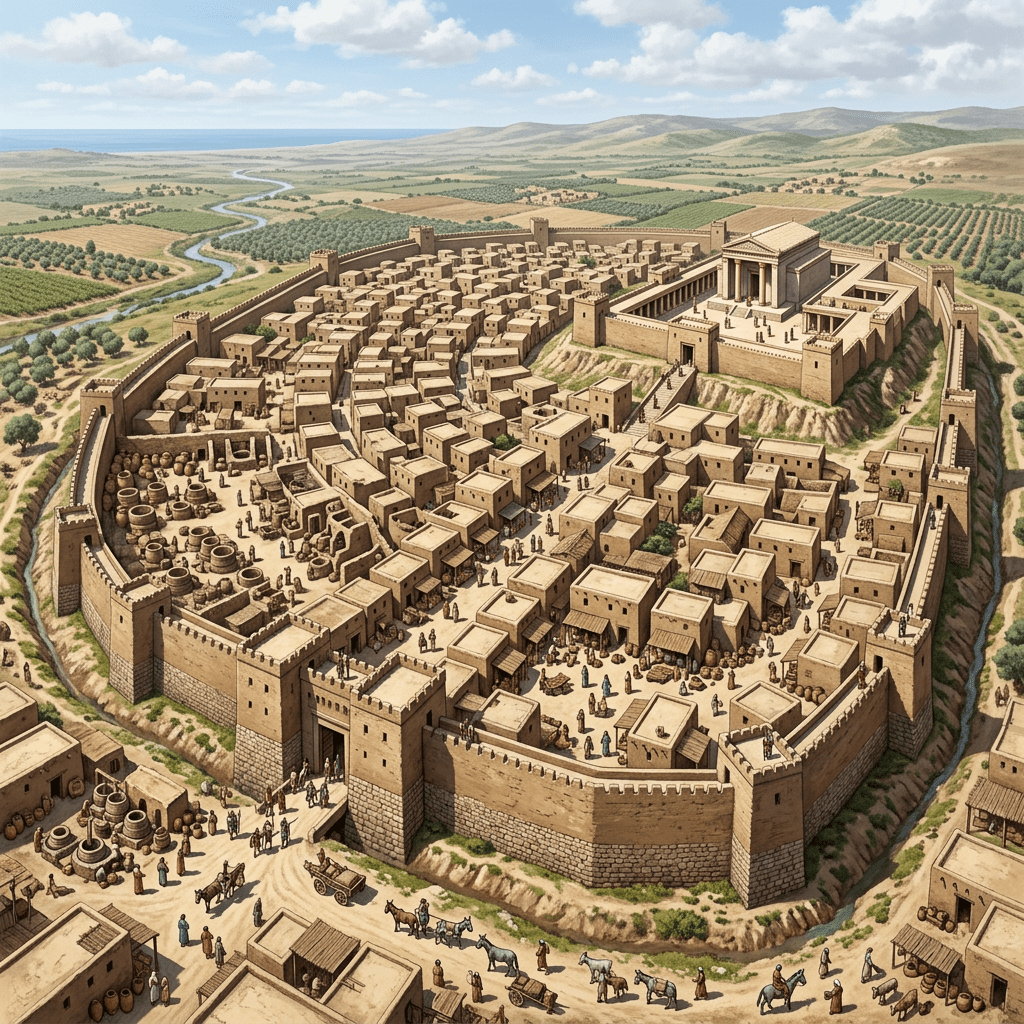
Modern archaeology has given strong support to the identification of Ekron with Tel Miqne, about 35 kilometers southwest of Jerusalem. Excavations led by Trude Dothan and Seymour Gitin uncovered one of the largest Iron Age cities in the land. The Anchor Bible Dictionary explains that the site contains evidence from many periods, including the Chalcolithic, Bronze Age, Iron Age, and later times (Freedman et al., The Anchor Bible Dictionary, 415–22).
The discoveries at Ekron are especially important for understanding Philistine life. Archaeologists found Aegean-style pottery, cultic objects, industrial installations, and large structures. The New Encyclopedia of Archaeological Excavations in the Holy Land describes Ekron as one of the richest Philistine sites ever uncovered, with evidence of religion, industry, and urban development (Ephraim Stern, Ayelet Lewinson-Gilboa, and Joseph Aviram, eds., The New Encyclopedia of Archaeological Excavations in the Holy Land, vol. 3, ed. Trude Dothan and Seymour Gitin [Israel Exploration Society & Carta; Simon & Schuster, 1993], 1052–58).
Archaeology therefore helps us see that Ekron was a real and powerful city. The Bible does not speak of a myth or legend. It speaks of a place rooted in history. Yet the ruins also preach their own sermon: what once appeared strong and glorious now lies silent under the dust.
Ekron’s Great Industry and Final Fall
One of the most remarkable discoveries at Ekron was its vast olive oil industry. More than one hundred olive oil installations were found there. According to The Anchor Bible Dictionary, this made Ekron the largest known olive oil production center in the ancient Near East, capable of producing around 1,000 tons annually (Freedman et al., The Anchor Bible Dictionary, 415–22). Along with this, many loom weights point to a strong textile industry.
Another major discovery was the Ekron dedicatory inscription. Barry notes that this inscription mentions Ikausu, ruler of Ekron, and the goddess Ptgyh, strongly confirming the identification of Tel Miqne as biblical Ekron and shedding light on its religious life (Barry, The Lexham Bible Dictionary).
But Ekron’s greatness did not last. Its destruction likely came during the Babylonian campaigns, perhaps around 603 BC. The city that had once stood in strength, trade, and religious confidence was brought low. In the end, it could not escape the word spoken by the prophets.
This is the final earthly lesson of Ekron: all human glory fades. A city may be large, rich, fortified, and famous, but if it stands against God, its greatness will not remain.
Echoes of Ekron’s Spirit
When we gather together the witness of Scripture, history, and archaeology, Ekron speaks with one voice. It was a city of conflict. It was a city of idols. It was a city that saw the power of God, yet remained known for resisting Him. It was a city that prospered for a time, yet finally fell under judgment.
Ekron teaches that promised land can still become a battleground when God’s people do not fully obey. It teaches that idols cannot save. It teaches that God’s holiness is terrible to His enemies. It teaches that wealth and power cannot protect those who live in rebellion. Above all, it teaches that the Lord rules over all nations, all kings, and all history.
The Voice of Ekron’s Ruins
Ekron should not be remembered only as a Philistine city of the past. It should be remembered as a solemn witness for the present. Its story calls us to examine where we place our trust. Are we seeking the living God, or are we turning to the idols of our age—human wisdom, wealth, power, reputation, or worldly security? The sin of Ahaziah is still repeated whenever men look everywhere except to God.
The fall of Ekron stands as a warning, but also as a call. It calls us to forsake false trusts and return to the Lord alone. The city that once opposed God now lies in ruins, but the God who judged Ekron still lives and reigns forever. Therefore let every heart learn this lesson well: only the Lord is worthy of our faith, our worship, and our obedience. Everything else will fall, but His kingdom shall never be moved.
JONATHAN SAMUEL KONALA M.TECH., M.TH
 Jonathan Samuel's Pilgrim Thoughts
Leave a comment